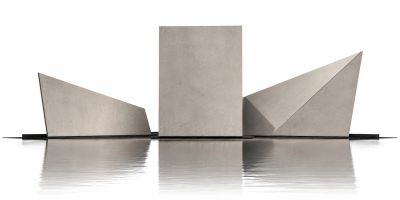
OBSERVATION
The FOLD becomes an architectural Asterism - a constellation invented through geometry, symmetry, and reflection.
THE EVOLUTION OF THE THEORY OF THE FOLD
The theory of THE FOLD began as an investigation into the act of transformation rather than the creation of a particular architectural form. At its foundation is the idea that architecture can emerge through a process of change: a surface, boundary, condition, or idea is altered until something new begins to exist between its original state and its transformed state. The Fold therefore became less a formal language and more a way of thinking about architecture as a continuous process of becoming. It is concerned not with the object as a finished thing, but with the forces, decisions, relationships, and conditions that allow the object to come into existence.
Initially, the Fold was understood through a physical action: something that is flat is displaced, something that is continuous is interrupted, and something that is singular becomes multiple. But as the investigation developed, the physical action became secondary to the conceptual condition it produced. The Fold became a proposition about change itself. It suggested that transformation does not require the complete destruction of what existed previously. Instead, transformation can preserve traces of an earlier condition while simultaneously establishing something new.
As the theory developed, the Fold began to represent the moment when one condition encounters another. It became a threshold between inside and outside, permanence and change, mass and absence, concealment and revelation. To fold is to bring conditions together without completely resolving their differences. The resulting space exists within that tension. It is neither entirely one condition nor the other, but a new state created through their interaction. In this sense, the Fold is not simply an object or an architectural gesture; it is a method for understanding how relationships are created, altered, and experienced.
This distinction separates THE FOLD from an architecture based primarily on formal expression. The Fold is not intended to become a recognizable style or a collection of repeated visual characteristics. It is a generative principle. Its physical expression may change from project to project because the conditions being transformed may also change. The Fold can therefore produce different architectural outcomes while maintaining the same underlying intellectual position.
This shift is important because the Fold is not understood as an aesthetic device. It is not simply the act of bending a surface or producing an angular form. Its significance lies in what transformation makes possible. A fold can create separation while simultaneously establishing connection. It can obscure one condition while revealing another. It can compress space, extend perception, redirect movement, establish a threshold, produce a moment of pause, or create an unexpected relationship between interior and exterior. The physical fold becomes a mechanism through which architecture can organize experience.
The development of THE FOLD consequently moves from the physical act of folding toward a broader philosophical proposition. The Fold can occur within a material, a surface, a space, a sequence, a memory, or even an idea. It can compress experience, reveal something previously concealed, create a new relationship between fragments, or alter the way a person moves through space. What begins as a physical transformation consequently becomes a study of perception, memory, movement, and experience.
The Fold becomes a way of understanding how one condition can contain the possibility of another.
Within this evolving theory, transformation is never understood as a simple transition from one state to another. The important condition is the interval between them. The Fold occupies this interval. It is the moment in which something is no longer what it was, but has not yet become something entirely different. This unresolved state becomes architecturally productive. It allows ambiguity to exist as a deliberate condition rather than as a failure of definition. Space can be simultaneously open and enclosed, familiar and unfamiliar, exposed and protected.
The Fold therefore becomes a theory of the in-between. It is concerned with the spaces that are produced when categories begin to overlap. A threshold is no longer simply a line separating two rooms; it can become a place of occupation. A wall is no longer merely a boundary; it can become a spatial event. A roof can become enclosure, landscape, structure, and movement simultaneously. The Fold expands the architectural understanding of these elements by allowing them to exist between established categories.
The architecture of THE FOLD is therefore understood as evidence of a process rather than the final expression of a predetermined form. Its planes, voids, intersections, thresholds, and moments of enclosure are manifestations of an underlying theory: that architecture can be generated through transformation, and that transformation can become a generator of meaning. The Fold does not seek to return to an original condition. Instead, it creates a third condition—something that exists because the original has been changed.
This third condition is central to the theory. Transformation does not simply produce an altered version of the original; it produces a new relationship between what was and what is. The Fold is where that relationship becomes visible. It allows the past and present to occupy the same conceptual field without requiring one to disappear. Architecture consequently becomes an instrument for making transformation perceptible.
This idea also allows THE FOLD to be understood as a theory of accumulation. Each transformation carries evidence of what existed before it. The new condition does not completely erase the previous one; it contains traces of it. A fold therefore becomes a record of action. It holds memory within its altered state. In architecture, this suggests that buildings and spaces can be understood not only through their physical presence but through the transformations, histories, movements, and experiences embedded within them.
The Fold can therefore operate as a form of architectural memory. It suggests that every intervention carries a relationship with something preceding it. This becomes particularly significant in architecture concerned with existing buildings, landscapes, ruins, heritage, and adaptive reuse. Rather than treating the existing condition as something to be erased or concealed, the theory of the Fold allows the new to emerge through a dialogue with what is already present. Transformation becomes an act of continuation rather than replacement.
The Fold also introduces the idea of architecture as movement without requiring literal movement. A stationary surface can imply direction. A wall can suggest displacement. A threshold can create anticipation. A void can imply something that has been removed. Architecture can therefore communicate transformation through its physical relationships, allowing the viewer to perceive movement within something that is materially still. The building becomes a frozen record of an action that appears to have occurred—or that might still be occurring.
From this perspective, THE FOLD becomes an investigation into the relationship between stability and change. The central condition may remain fixed while surrounding conditions transform. A boundary may establish order while simultaneously being disrupted. A space may appear contained while continually directing the body beyond itself. These oppositions are not problems to be resolved; they are the conditions through which the architecture gains meaning.
The theory also begins to challenge the conventional idea of the architectural object as an autonomous thing. THE FOLD suggests that architecture is better understood as a relationship between conditions. A building does not exist independently of movement, light, landscape, material, memory, climate, or the body. These forces continually alter the way the architecture is perceived. The Fold becomes the conceptual space in which these relationships meet.
Consequently, the theory is not limited to physical architecture. It can extend into drawing, installation, landscape, furniture, material research, writing, and spatial experience. Wherever one condition is transformed into another, the Fold can become a method of inquiry. Its value lies in its ability to generate questions rather than provide a predetermined answer.
The Fold also proposes that incompleteness can be productive. A transformation does not always need to arrive at a perfectly resolved state. There can be value in the moment of transition, in the condition where opposing forces remain visible. This creates an architecture that allows the viewer to perceive process rather than simply consume an image of completion.
Ultimately, THE FOLD proposes architecture as a state of continual becoming. It is concerned with what happens between conditions: between one surface and another, between separation and connection, between stillness and movement, between memory and presence, between permanence and change, and between what is perceived and what remains concealed. The Fold is not the object of the study. The Fold is the theory of transformation itself.
It proposes that architecture does not necessarily begin with form. It can begin with a condition, a question, a tension, a memory, or an act of change. Form is then allowed to emerge from the consequences of that transformation. In this way, THE FOLD becomes an open-ended architectural theory—one that does not prescribe a particular shape, material, scale, or program, but establishes a way of thinking about how space can come into being.
The evolution of the theory ultimately moves from folding as an action, to the Fold as a condition, and finally to the Fold as a method of architectural thought. What began as a physical investigation becomes a broader inquiry into transformation, continuity, perception, memory, and experience. The Fold becomes less about what architecture looks like and more about what architecture can do: connect, separate, reveal, conceal, compress, expand, remember, and transform.
The Fold is the moment of change made spatial. It is the trace of transformation, the space between conditions, and the possibility of becoming something other than what existed before. It is not a form to be repeated, but a question to be continually asked: what can architecture become when transformation itself becomes the generator of space?